Last updated: October 16, 2026 · The federal rule and every center policy below were checked on the official FDA regulation (eCFR) and on each plasma chain’s own website on October 16, 2026. Center policies and promotions can change, so confirm with your local center before you plan your week.


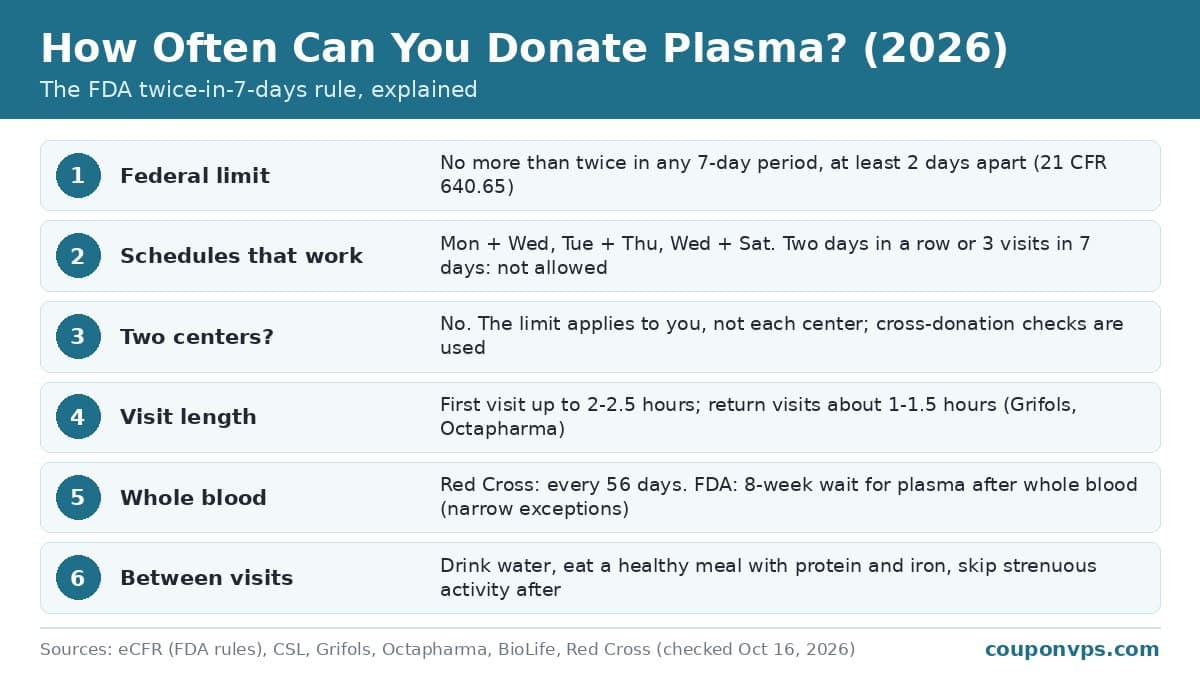
- How often: you can donate plasma up to twice in any 7-day period, with at least 2 days between donations. That’s the FDA limit, and it applies at every plasma center in the U.S.
- In practice: Monday and Wednesday, Tuesday and Thursday, or Wednesday and Friday all work. Two days in a row (Monday and Tuesday) does not.
- Two centers don’t double it: the limit applies to you as a donor, not to each center, and the industry runs systems to catch donors who try.
- Time per visit: about 2 to 2.5 hours for a first visit and roughly 1 to 1.5 hours for return visits, according to Grifols and Octapharma Plasma.
- Whole blood is different: the American Red Cross accepts whole blood every 56 days, so the twice-a-week rule only applies to plasma.
“How often can you donate plasma?” sounds like it should have one simple answer, and it mostly does: twice a week. But the exact wording of the rule matters. It’s not “two donations per calendar week.” It’s “no more than twice in 7 days, and never less than 2 days apart,” and that changes which days you can actually book.
Below, we break down the federal rule in plain English, show real weekly schedules that follow it, explain why you can’t stretch it by visiting two centers, and look at how the twice-a-week pace ties into new-donor pay. Everything is based on the regulation itself and on what CSL Plasma, BioLife, Grifols and Octapharma publish on their own sites.
The federal limit: what the FDA rule actually says
Plasma donation frequency in the U.S. is set by federal regulation, not by each company. The FDA’s rule for source plasma (21 CFR 640.65, which 21 CFR 630.15 points to for frequency limits) says that collection “shall not occur less than 2 days apart or more frequently than twice in a 7-day period.”
Every major chain repeats the same limit on its own site:
| Source | What it says about frequency | Visit length it publishes |
|---|---|---|
| FDA regulation (21 CFR 640.65) | Not less than 2 days apart, no more than twice in a 7-day period | Not specified |
| CSL Plasma | Maximum “once in a two-day period” and “no more than twice in a seven-day period” | “About 90 minutes to two hours” |
| BioLife Plasma Services | “Twice in a 7-day period (week) but not more than once in a 2-day period” | Not stated on its frequency page |
| Grifols Plasma | “Up to two times in a seven-day period” | First visit 2 to 2.5 hours; return visits 1 to 1.5 hours |
| Octapharma Plasma | Two donations within 7 days, “with at least 2 days in between” | First visit up to 2 hours; return visits about 1 to 1.5 hours |
Quoted from each official page on October 16, 2026. Your center can still defer you on any given day if you don’t pass that day’s screening.
Why is plasma allowed so often? CSL Plasma explains that “your body replaces the donated plasma within 24 to 48 hours,” and during plasmapheresis your red blood cells are returned to you. The industry group PPTA says frequency limits are “set to protect the long-term health of the donor.”

What “2 days apart” means for your weekly schedule
The two parts of the rule work together. You need at least one full day off between donations, and you can’t fit a third donation into any rolling 7-day window. Some chains describe the gap as 48 hours, so your center’s app or front desk has the final word on your earliest return time.
| Schedule | Follows the rule? | Why |
|---|---|---|
| Monday + Wednesday | Yes | One day off between visits, two donations in 7 days |
| Tuesday + Thursday | Yes | Same pattern; popular with weekday workers |
| Wednesday + Saturday | Yes | A longer gap is always fine |
| Monday + Tuesday | No | Less than 2 days apart |
| Monday, Wednesday, Friday | No | Three donations in a 7-day period |
| Friday + Monday (next week) | Yes | The 7-day window rolls, so a weekend gap counts |
Pick two fixed days and keep them. A steady rhythm makes it easier to hydrate and eat well beforehand, and it keeps you on track for new-donor promos that require several visits in a short window.
Plasma vs. whole blood vs. platelets
The twice-a-week rule is specific to plasma collected at plasma centers. Blood donation rules are very different, which is a common source of confusion. Here’s what the American Red Cross publishes for its donation types:
| Donation type (Red Cross) | How often | Approximate time |
|---|---|---|
| Whole blood | Every 56 days, up to 6 times a year | About 1 hour |
| Power Red | Every 112 days, up to 3 times a year | About 1.5 hours |
| Platelets | Every 7 days, up to 24 times a year | About 2.5 to 3 hours |
| AB Elite plasma | Every 28 days, up to 13 times a year | About 1 hour 15 minutes |
Note that the Red Cross’s own AB Elite plasma program has a longer interval than paid plasma centers. If you give whole blood, federal rules also make you wait before donating plasma: the FDA requires an 8-week deferral after a unit of whole blood (with a narrow exception for some devices), so tell the plasma center about any recent blood donation.
Can you donate plasma at two different centers?
No, not to get around the limit. The twice-in-7-days rule applies to you, so a donation at CSL on Monday and one at BioLife on Tuesday still breaks it. Grifols warns that donating at multiple centers to get around the limit “can lead to permanent disqualification and potential health complications.”
Centers also check. PPTA, the plasma industry association, has a Cross Donation Management standard in its quality program because “a donor may attempt to donate more often than is allowed,” and when PPTA launched its Cross Donation Check System in 2015, the database was announced as in use at more than 400 U.S. centers. Separately, the National Donor Deferral Registry (NDDR) lists permanently deferred donors, and new donors are checked against it at participating centers.
Switching centers is fine when you move or simply prefer another location. Just let the new center know when you last donated, and expect to go through new-donor screening again.

How donation frequency affects your pay
Plasma pay is per visit, so frequency directly shapes what you earn. New-donor promotions are built around the twice-a-week pace:
- Octapharma Plasma advertises “up to $750*” in your first 35 days. Your first donation payment can’t be used until you complete the second, and you need to return within 14 days of your first visit (*may vary by location).
- CSL Plasma advertises “up to $100*” for your first donation and “up to $800*” in your first month as a new donor (*varies by location and is subject to change).
These “up to” figures usually assume you complete every qualifying visit in the window, and most chains also pay by body weight. Miss a week and you may lose part of the promo. For a full side-by-side of current offers, see our highest paying plasma centers guide.
Recovery tips between donations
Donating twice a week is routine for many donors, but how you prepare makes a difference. From the chains’ own advice:
- Drink plenty of water the day before and the day of your donation. Octapharma notes that “donors who are fully hydrated will reduce the donation time by several minutes.”
- Eat a healthy meal before you go and skip high-fat foods (CSL Plasma).
- Keep an iron- and protein-rich diet to support healthy plasma levels (Octapharma).
- Avoid alcohol, tobacco and caffeine the day before and the day of your donation (Grifols).
- Take it easy afterward: stay hydrated and avoid strenuous physical activity after donating (CSL Plasma).
- Follow your center’s nutrition guidance. BioLife tells donors to follow the guidelines shared by its Medical Support Specialist.
Common mistakes to avoid
- Counting by calendar week. The rule uses a rolling 7-day period, so Friday, Monday and Wednesday is three donations in 6 days, which is too many.
- Booking back-to-back days. You need at least 2 days between donations.
- Not mentioning a recent blood donation. Whole blood triggers a federal deferral from plasma donation.
- Showing up dehydrated or on an empty stomach. It can slow your donation or lead to a deferral that day.
Related deals
- What to bring to your first plasma donation: ID, proof of address and the documents centers ask for.
- Highest paying plasma centers: national new-donor offers compared chain by chain.
- CSL Plasma coupons and bonus rewards: the up-to-$800 first month and iGive Rewards.
- BioLife coupon and new donor pay: how to find your local center’s promo.
- Grifols plasma bonus coupon codes: referral program and DonorHub offers.
- Octapharma Plasma new donor bonus: the up-to-$750 first-35-days promo.
Frequently asked questions
How many times a week can you donate plasma?
Twice. FDA rules allow no more than two plasma donations in a 7-day period, with at least 2 days between them, at any U.S. plasma center.
Can I donate plasma two days in a row?
No. Donations must be at least 2 days apart, so if you donate Monday, Wednesday is the earliest day you can return.
Can you donate plasma at two different places in the same week?
Not to exceed the limit. The twice-in-7-days rule applies to you as a donor, centers use industry cross-donation checks, and Grifols warns that donating at multiple centers to get around the limit can lead to permanent disqualification.
How long does it take to donate plasma?
Plan on up to 2 to 2.5 hours for your first visit and roughly 1 to 1.5 hours for return visits: Grifols quotes 2 to 2.5 hours for a first donation, Octapharma up to 2 hours, and both say return visits take about 1 to 1.5 hours. CSL Plasma says a donation usually takes about 90 minutes to two hours.
Why can you donate plasma more often than blood?
Because your red blood cells are returned to you during plasma donation and your body replaces plasma quickly, within 24 to 48 hours according to CSL Plasma. Whole blood removes red cells, so the Red Cross accepts it only every 56 days.
Sources: 21 CFR 640.65 (eCFR), 21 CFR 630.15 (eCFR), CSL Plasma FAQ, CSL Plasma rewards, BioLife: how often can you donate plasma, Grifols: how often can you donate plasma, Grifols Plasma FAQ, Octapharma Plasma FAQ, Octapharma new donors, PPTA IQPP standards, PPTA NDDR, PPTA plasma FAQs, American Red Cross donation types (checked October 16, 2026).
CouponVPS is not affiliated with CSL Plasma, BioLife Plasma Services, Grifols, Octapharma Plasma, the Plasma Protein Therapeutics Association (PPTA), the American Red Cross or the FDA. This article is for general information only and is not medical advice. Donation rules, eligibility and compensation are set by regulators and each company, vary by location and may change at any time. Always follow your center’s medical staff and check its official website or app.
-

-
-
-