
Last updated: October 2026 · The federal rule, PPTA’s industry standards and each chain’s official FAQ were checked on October 21, 2026. Center policies can change, so confirm with your local center before you switch.
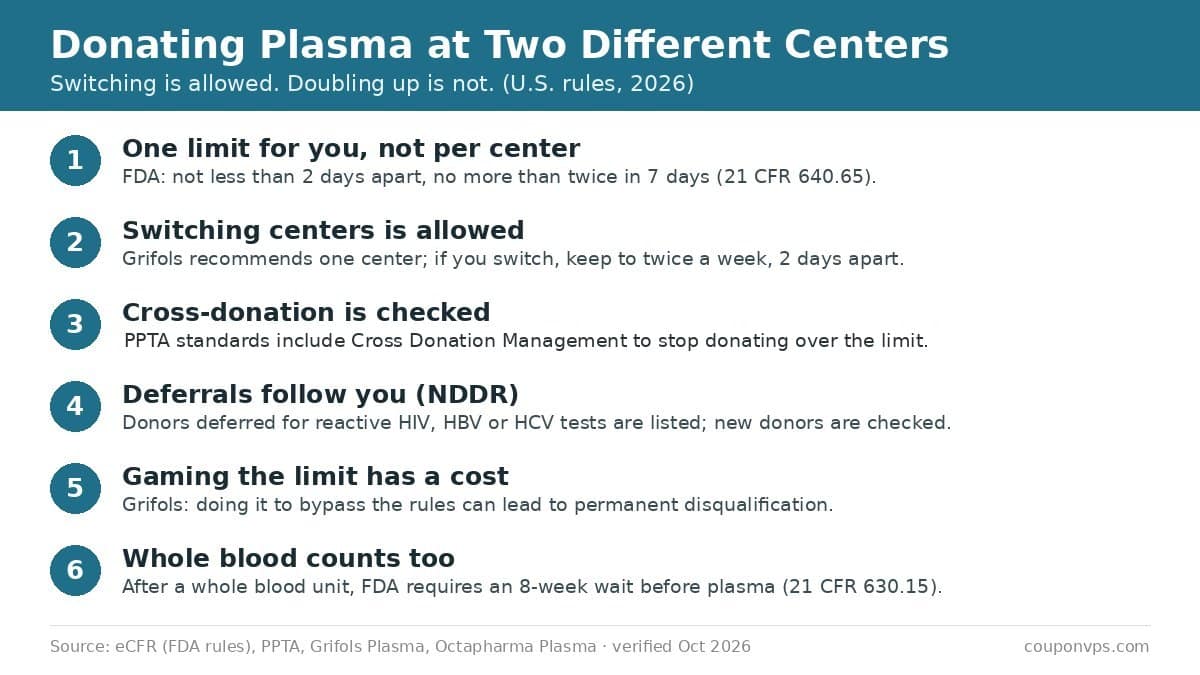
- Yes, you can donate plasma at two different centers, but not to go over the limit: the FDA cap of no more than twice in 7 days, at least 2 days apart, applies to you across every center combined.
- Switching is fine: Grifols recommends sticking to one center, but says that if you have to switch, keep following the twice-a-week, two-days-apart limit.
- Doubling up is risky: Grifols warns that donating at multiple centers to bypass the guidelines “can lead to permanent disqualification.”
- The industry checks: PPTA’s quality standards include a Cross Donation Management standard, and the National Donor Deferral Registry (NDDR) lists donors who are permanently deferred after reactive HIV, HBV or HCV tests.
- Staying in one chain? Octapharma says transferring between its centers “won’t affect your donor qualification status” and can be done at a kiosk.
Maybe you moved, changed jobs or found a center with a better new-donor offer. Can you just walk into a different plasma center, or even use two at once? We checked the federal regulation, the Plasma Protein Therapeutics Association (PPTA) standards and the official FAQs of CSL Plasma, BioLife, Grifols and Octapharma (verified October 2026). Here’s what they actually say.
The short version: one donor, one limit
Plasma frequency limits in the U.S. come from federal regulation, not from each company. 21 CFR 630.15 points to 21 CFR 640.65 for frequency, and that rule says collection “shall not occur less than 2 days apart or more frequently than twice in a 7-day period.” The limit protects your body, so it follows you from center to center.
| Scenario | Allowed? | Why |
|---|---|---|
| Moving from one center to another (same or different company) | Yes | Grifols says that if you have to switch, keep following the FDA limits |
| Center A on Monday, Center B on Thursday, nothing else that week | Yes, within the limit | Two donations in 7 days, more than 2 days apart |
| Center A on Monday, Center B on Tuesday | No | Less than 2 days apart |
| Twice a week at Center A plus once at Center B | No | Three donations in a 7-day period |
| Whole blood at a blood drive, then plasma a few days later | Usually no | FDA requires an 8-week plasma deferral after a whole blood unit (narrow device exception) |
Based on 21 CFR 640.65, 21 CFR 630.15 and the Grifols Plasma FAQ, checked October 21, 2026. Your center can still defer you on any day you don’t pass screening.
What each plasma chain says about donating elsewhere
Not every chain answers this question directly on its website. Here’s what we found on each official site:
| Chain | Multiple centers / switching | Frequency it publishes |
|---|---|---|
| Grifols Plasma | Recommends donors “stick to one center”; if you switch, keep to twice a week and two days between donations. Bypassing the limits at multiple centers can mean permanent disqualification. | Up to two times in a seven-day period |
| Octapharma Plasma | Transferring between Octapharma centers “won’t affect your donor qualification status” and can be completed at a kiosk; staff at the new center can help. | Two donations within 7 days, at least 2 days in between |
| CSL Plasma | No public FAQ on switching; it directs donors to their local center. Each center sets its own marketing radius for promotions. | Once in a two-day period, no more than twice in seven days |
| BioLife Plasma Services | No public FAQ on switching found; check with your local center. | Twice in a 7-day period, not more than once in a 2-day period |
One practical point: promotions are usually tied to a company or a single center. Octapharma says each of its centers “runs its own special plasma donation promotions,” and CSL’s referral program requires the referred person to be a new donor “with no prior donations at CSL Plasma.” So a new-donor bonus at one chain doesn’t carry over, and switching doesn’t automatically make you a “new donor” everywhere. Read each offer’s terms.
How centers catch cross-donation: CDCS and the NDDR
The plasma industry runs two separate safeguards through PPTA’s International Quality Plasma Program (IQPP). They’re often confused, so here’s what each one does, based on PPTA’s own descriptions:
| System | What PPTA says it does | Who gets checked |
|---|---|---|
| Cross Donation Management standard / Cross Donation Check System (CDCS) | The standard “addresses the potential risk of cross donation,” noting a donor “may attempt to donate more often than is allowed.” PPTA also describes a Cross Donation Check System (CDCS) that helps member centers check donors. | Used by participating PPTA member centers; PPTA does not publish what data it checks |
| National Donor Deferral Registry (NDDR) | Lists donors who tested reactive for HIV, HBV or HCV and are permanently prohibited from donating, so they “do not donate in other facilities.” | People who have never donated at a participating center, and donors who haven’t donated at one in the preceding 6 months |
In other words, the NDDR is about permanent deferrals, while the cross-donation standard is about frequency. PPTA doesn’t publish exactly what data the CDCS checks, so we won’t guess. The takeaway is simple: centers have industry tools designed to spot donors who try to exceed the limit, and you should assume your donations are visible.
How to switch plasma centers the right way
- Check your last donation date. Count a rolling 7 days and at least 2 days from your last visit, wherever it was.
- Staying in the same chain? Ask about a transfer. Octapharma lets you transfer at a kiosk with help from staff; for other chains, ask the new center’s front desk.
- Moving to a different company? Expect to register as a new donor there, with ID, proof of address and the first-visit screening. See our first-donation checklist.
- Be honest at screening. Tell staff when you last donated plasma or whole blood. The questions are there to protect you.
- Read the promo terms. New-donor offers and loyalty points are set by each company or center, and they can have their own rules about prior donations.
- Plan time for the first visit. A first visit at a new company usually takes longer than a return visit; our donation time guide has the figures each chain publishes.

Mistakes to avoid when using more than one center
- Thinking each center has its own limit. It doesn’t. The FDA frequency rule counts every plasma donation you make.
- Counting by calendar week. The 7-day period rolls, so Friday at one center plus Monday and Wednesday at another is three donations in 6 days.
- Hiding a recent donation. Grifols warns that bypassing the limits at multiple centers can lead to permanent disqualification.
- Forgetting about blood drives. A whole blood donation triggers an 8-week plasma deferral under 21 CFR 630.15, except in a narrow device-related case.
- Assuming a bonus transfers. New-donor and loyalty offers are company- or center-specific.
- Octapharma Plasma referral program
Related guides
- How often can you donate plasma?: the twice-in-7-days rule and sample weekly schedules.
- Highest paying plasma centers: new-donor offers compared chain by chain.
- How long does it take to donate plasma?: first visit vs. return visits.
- What to bring to your first plasma donation: ID, proof of address and SSN proof.
- CSL Plasma coupons and bonus rewards: new-donor pay and iGive Rewards.
Frequently asked questions
Can you donate plasma at two different places in the same week?
Only if your total stays within the federal limit: no more than two plasma donations in any 7-day period, at least 2 days apart. The limit applies to you, not to each center.
Do plasma centers know if you donate somewhere else?
Centers have industry tools for this. PPTA’s quality program includes a Cross Donation Management standard, and member centers can use its Cross Donation Check System to spot donors who try to give more often than the FDA allows.
What is the NDDR for plasma donors?
The National Donor Deferral Registry is a PPTA program listing donors who tested reactive for HIV, HBV or HCV and are permanently prohibited from donating. New donors at participating centers are checked against it.
Can I switch plasma centers?
Yes. Grifols recommends sticking to one center but says that if you switch, keep donating no more than twice a week with two days between visits. Octapharma lets donors transfer between its own centers without affecting qualification status.
What happens if you donate plasma at multiple centers?
Doing it to exceed the frequency limit can get you deferred. Grifols warns that donating at multiple centers to bypass the guidelines can lead to permanent disqualification and potential health complications.
Sources: 21 CFR 640.65 (eCFR), 21 CFR 630.15 (eCFR), PPTA IQPP standards, PPTA NDDR, Grifols Plasma FAQ, Octapharma Plasma FAQ, CSL Plasma FAQ, CSL Plasma return donors, BioLife: how often can you donate plasma. Verified on October 21, 2026.
CouponVPS is not affiliated with CSL Plasma, BioLife Plasma Services, Grifols, Octapharma Plasma, the Plasma Protein Therapeutics Association (PPTA) or the FDA. This article is for general information only and is not medical advice. Donation rules, eligibility and compensation are set by regulators and each company, vary by location and may change at any time. Always follow your center’s medical staff and check its official website or app.